How Africa and the Global South Risk Failing Their Brightest Minds And Why Rethinking Equity Is Urgent
15 May 2026
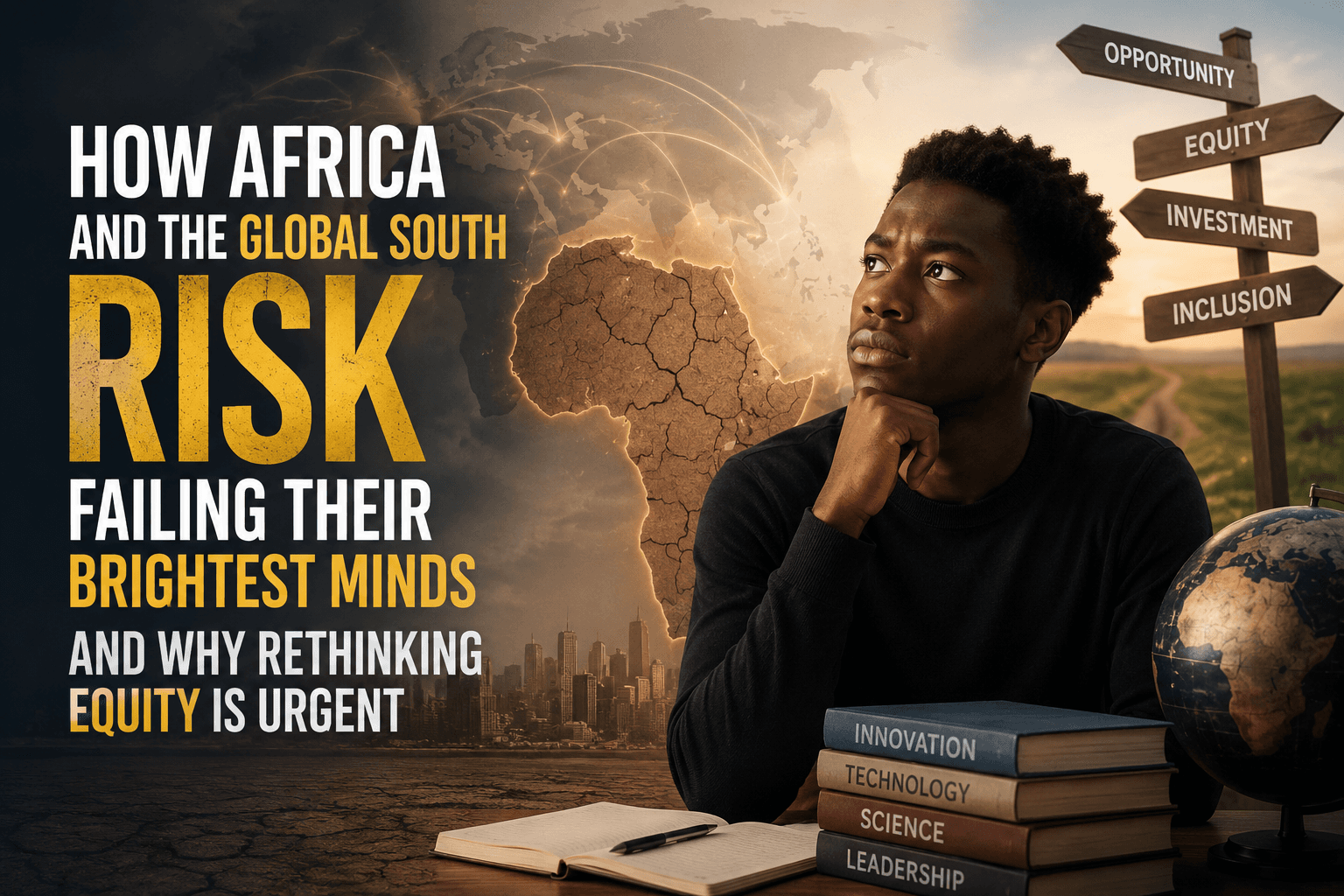
Imagine an eight-year-old finishing high school in 18 months, earning a Bachelor's degree at eleven, a Master’s degree at twelve, and a doctorate in quantum physics at fifteen. That’s Laurent Simons, the Belgian-Dutch prodigy who recently captured the attention and imagination of the world and is currently pursuing his second PhD in AI-powered medicine with the ambition of extending human life. This child prodigy raises a compelling question not just for one nation, but for an entire continent and much of the developing world: what if Laurent Simons had been born in Africa? What if he had emerged from Nairobi, Lagos, Dhaka, Kingston, São Paulo, Kampala, Lusaka, or any other corner of the Global South where brilliance is abundant, but systems are often unevenly prepared to accommodate it?
The uncomfortable truth is that across much of Africa and the developing world, probably not very well. While many countries officially recognize special needs education, intellectual giftedness remains weakly anchored in policy and inconsistently supported in practice. Even where education reforms promise inclusivity, structured systems for identifying and nurturing exceptional academic ability, especially in Science, Technology, Engineering, and Mathematics (STEM), are still rare. In many developing contexts, educational frameworks continue to prioritize mass access over nuanced excellence, standardization over personalization, and conformity over curiosity. The result is that academically gifted learners often find themselves trapped in systems designed to bring many to the baseline, but not necessarily to propel outliers toward their highest ceilings.
Ironically, Laurent would likely still be noticed early enough. Across African classrooms, teachers are often remarkably perceptive. They know the child who finishes every task too quickly, asks questions beyond the syllabus, or grasps concepts years ahead of peers. The challenge is rarely identification alone; it is what follows. Recognition and admiration without any pragmatic action.
In lower primary, Laurent would probably be celebrated. He would be paraded during assemblies, praised during prize-giving days, and held up as proof that “our children are capable.” But by upper primary, in overcrowded classrooms and exam-oriented systems, the celebration could begin to curdle into stagnation. Lessons would become repetitive. Curiosity could start to feel inconvenient. Teachers, burdened by large student-teacher ratios and national assessment pressures, might urge him to slow down, be patient, or help others catch up. Gradually, the subtle lesson would emerge: your brilliance is admirable, but only insofar as it does not disrupt the system’s rhythm.
By secondary school, rigidity would likely intensify. Across much of the developing world, progression remains deeply age-bound, curriculum pacing fixed, and acceleration pathways limited or viewed with skepticism. Questions about social maturity, emotional readiness, and institutional norms would arise, often valid in themselves, but too frequently weaponized as reasons to preserve outdated structures rather than redesign support systems. In this environment, extraordinary ability can begin to feel less like a gift and more like an administrative inconvenience.
Needless to say, Laurent the African or Global South prodigy would rarely be fast-tracked seamlessly into advanced research ecosystems. More often, he might be held back “for balance,” “for socialization,” or “for his own good.” He could be required to endure years of intellectual repetition, mastering concepts long before systems permit him to move forward. Boredom would likely arrive, followed by frustration, disengagement, eccentricity, or rebellion. In contexts where deviation from the norm is often poorly understood, giftedness can quietly be mislabeled as arrogance, stubbornness, or even instability. This is how many developing societies risk losing extraordinary minds-not always through poverty alone, but through systemic under imagination.
By late adolescence, several familiar trajectories might unfold. First, disengagement: a once- brilliant learner underperforms or drops out, not due to incapacity, but because prolonged under-stimulation has eroded motivation. Society then asks, often with genuine confusion, “Wasn’t that the bright child? What happened?” Second, social alienation: the learner becomes “too intense,” “too strange,” or “too difficult” for systems and communities more comfortable with conventional excellence than disruptive genius. Many societies celebrate talent when it conforms but can become suspicious when it transcends familiar templates.
Third, and perhaps most common among the exceptionally fortunate, external migration: parents, guardians, NGOs, scholarships, or international institutions identify what local systems cannot adequately support. The child leaves for Europe, North America, or specialized global institutions. Later, home countries proudly claim them as national success stories, despite the uncomfortable reality that another ecosystem did much of the nurturing. This pattern, while often celebrated, is also a quiet form of developmental leakage.
How many Laurents currently sit in African, Asian, or Latin American classrooms under- stimulated, misunderstood, or quietly shrinking themselves to survive systems that are still primarily designed around averages? How many potential innovators, scientists, physicians, engineers, and philosophers are being lost not because the developing world lacks genius, but because it too often lacks sufficiently adaptive frameworks?
UNESCO’s Global Education 2030 Agenda under Sustainable Development Goal 4 calls not merely for access to education, but for inclusive and equitable quality education that promotes lifelong learning opportunities for all. “For all” must include not only those historically excluded from classrooms, but also those whose exceptional capacities require systems flexible enough to let them advance. Equity cannot simply mean sameness; it must also mean responsiveness to exceptionality and neurodivergence.
This demands more than rhetoric. Across Africa and the developing world, effective intervention should begin with early identification of exceptional learners through reliable assessments, sustained observation, and teacher training. Some countries, including Kenya through initiatives like the Kenya Institute of Special Education’s Gifted and Talented Diagnostic Tool, are beginning to gesture in this direction. Yet isolated tools are not enough without broad awareness, implementation, and policy coherence.
This must be followed by flexible pathways: enrichment programmes, adaptive curricula, mentorship networks, specialized academies, STEM incubators, project-based learning, and where appropriate, structured acceleration. Equally critical is safeguarding the social and emotional wellbeing of gifted learners, whose exceptional intellect can also carry unique vulnerabilities.
For the developing world, this is not a luxury issue. It is a strategic imperative. Nations seeking innovation-driven growth, scientific sovereignty, and sustainable development cannot afford to educate brilliance as though it were a behavioral problem.
We are in 2026. The future of Africa and the Global South will depend not only on expanding access to education, but on whether our systems can evolve from merely schooling populations to truly cultivate potential at every level. We cannot keep asking brilliance to shrink itself to fit rigid systems, then lament brain drain, lost innovation, or unrealized greatness. You cannot break the wings of a bird, confine it to the cage of uniformity, and then wonder why it never learned to soar.
Written By: Eric Karuti - Kenya