Democracy in the Age of Curated Attention
17 Jun 2026
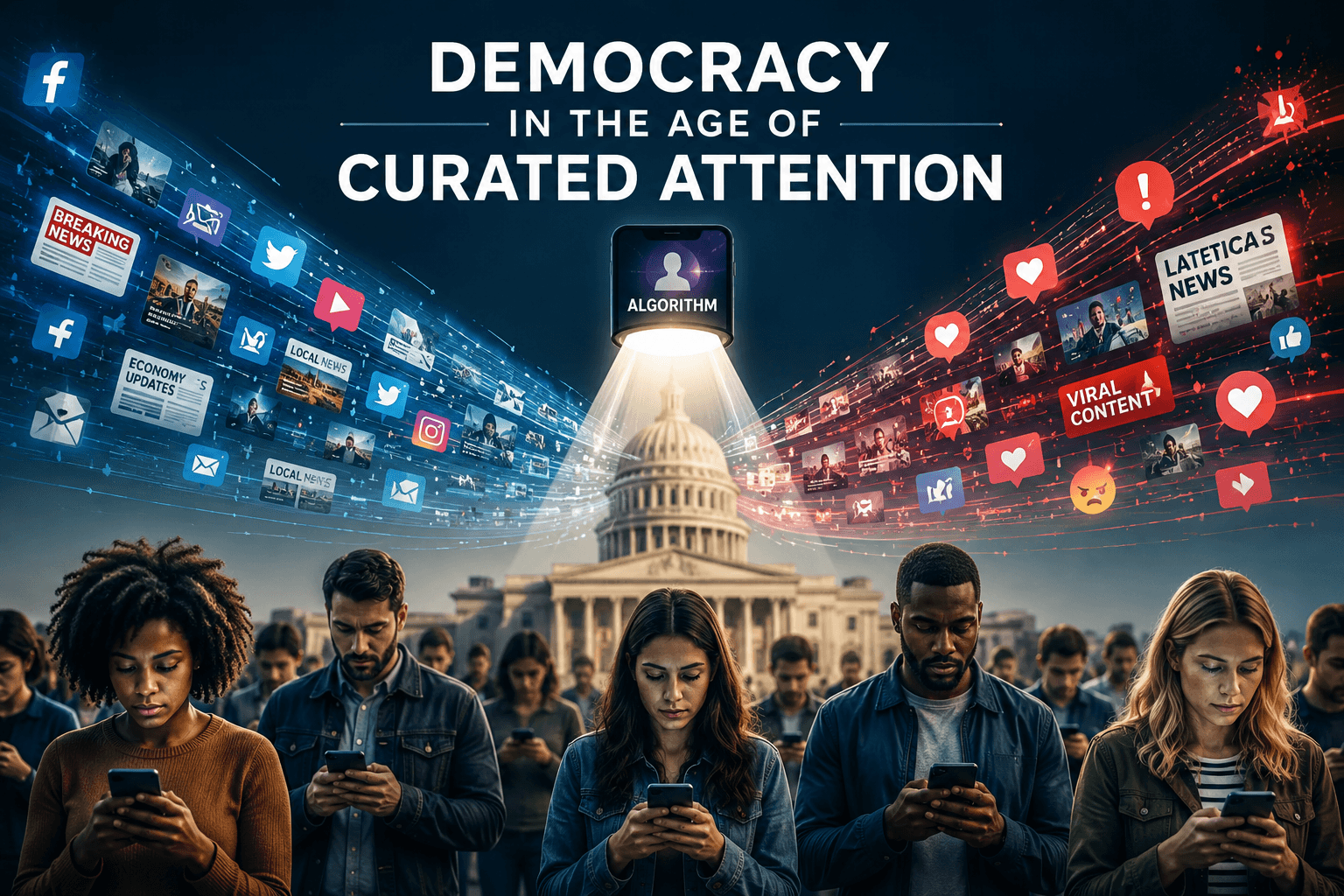
In contemporary civic discourse, there is no shortage of loud voices, quick conclusions, and extreme convictions. At first glance, they appear to be an active engagement in civic processes, but upon closer inspection, their sound can be best described as confusion posing as confidence.
Through You Are Not Alone, an initiative focused on the impact of excessive emotions on human behavior, one message has become clear: youths are not apathetic about public affairs, they are highly vulnerable to them. Vulnerable to ideas presented in the context of opinions, anger without knowledge, and stories that require a reaction rather than contemplation. This isn’t a sign of youth indifference. Instead, it’s a product of their surroundings.
While many young people used to learn about politics in educational spaces and civic forums, nowadays, they get exposed to politics through fragments – short videos, headline news, and forwarded posts. These fragments seldom provide insights into political mechanisms or consequences. Instead, they favor haste, firmness, and emotions. With time, contemplation turns into recitals, and questions become mere echoes of previous answers.
It is most obvious through the pattern of dissemination of viral crime stories. In cases where one particular crime occurs and ends up being posted online, usually with women, relationships, and/or violence involved, the matter is immediately distilled into simple images or text meant to arouse emotion. Anger becomes quickly heightened, and calls for extreme action or immediate justice are made. The processes, socio-political, psychological, or other considerations have little part in the matter. Once the outrage dissipates, the story dies, and nothing has been learned about what happened or how to fix things.
The same is true about explanations about social changes directed towards younger people. Perhaps the most common ideology propagated via various social networks and talk shows is
the claim that women being educated and working outside their homes have caused more divorces. This notion is widely propagated via memes, video clips from talk shows, and personal opinions expressed on video in a manner that does not require any particular analysis; instead, it appeals to the common sense of the audience. The reality of unpaid care work, stress at work, domestic violence, evolving expectations, and the changing laws is disregarded. All young people see is an oversimplified explanation for social changes that makes them believe in restrictive ideologies rather than look for solutions to the problem.
Ideology is not always reasonable. Often, it is appealing.
Selective attention plays a role even when the subject is protest or political conflict. One short video, maybe just a minute long, depicting a confrontation, arrest, or emotionally charged speech is all that it takes to spark a chain reaction. Captions will declare this incident either as the ultimate instance of total injustice or ultimate evidence of total justification, without considering what led up to the situation or what came afterwards or what laws are involved or different viewpoints that could possibly be out there. For some viewers, the video is the whole story. This form of activism is legitimate, but superficial. It promotes a knee-jerk response instead of thought-out action. Democracy ceases to function when our public discourse degenerates into emotionally appealing snippets.
In such environments, anger is not just an emotional reaction but rather a shortcut to social acceptance. Expressing outrage ensures rapid visibility and connectivity in today’s confusing reality. At the same time, this kind of persistent and regular emotional arousal does not leave much room for patience and rational deliberation. Last but not least, it also silently contributes to psychological health issues, leaving young people in a state of continuous urgency.
Once a large part of the population starts reacting the same way, individual opinion becomes public pressure. Political elites and governments, who are always eager to maintain their popularity, feel forced to act in response to apparently overwhelming public demand. Policies start to cater to emotions and not real problems. What we see here is not the dramatic collapse of democracy; it is rather the transformation of the democratic process driven by uninformed urgency.
You Are Not Alone pays attention to this process due to a vicious circle between psychological distress among youth and public narrative distortions. Young people get involved in endless emotional processes that make them anxious, angry, but also force them to react regardless of their desire to comprehend the reasons behind all that mess.
What is lacking is neither intellect nor passion. It is an interpretation. Young people learn how to excel, compete, and articulate their ideas confidently, but very few are taught how to deconstruct narratives, recognize emotional manipulation, or even how to be comfortable in their uncertainties. While they are asked to communicate, they are never instructed to listen.
It is on this basis that You Are Not Alone asserts the importance of spaces for reflective conversations along with those for assertive communication. This is not meant as an instruction to young people to form opinions. Rather, it is an attempt to make society understand that thinking itself requires space. When one is given the opportunity to pause, inquire, and acknowledge uncertainties, the process changes. A reaction evolves into contemplation. Certainty allows space for doubt.
These are not meant as criticisms of youth involvement, political passion, and public rage. Rather, they are expressions of worry about such involvement without foundation, passionate voices without thought, and angry outbursts without reflection. Confusion, noise, and emotions are not neutral elements. For instance, if children are never taught to think in a thoughtful manner, then they will keep on thinking in an aggressive manner. Aggression without thoughtfulness has never succeeded in creating a lasting democracy. We need to have more speakers and dialogues at schools, colleges, and communities, just like we have motivational speakers invited frequently, not for applause, but for the development of thinking and inquiry before responding.
Written By: Daraa Patel - India